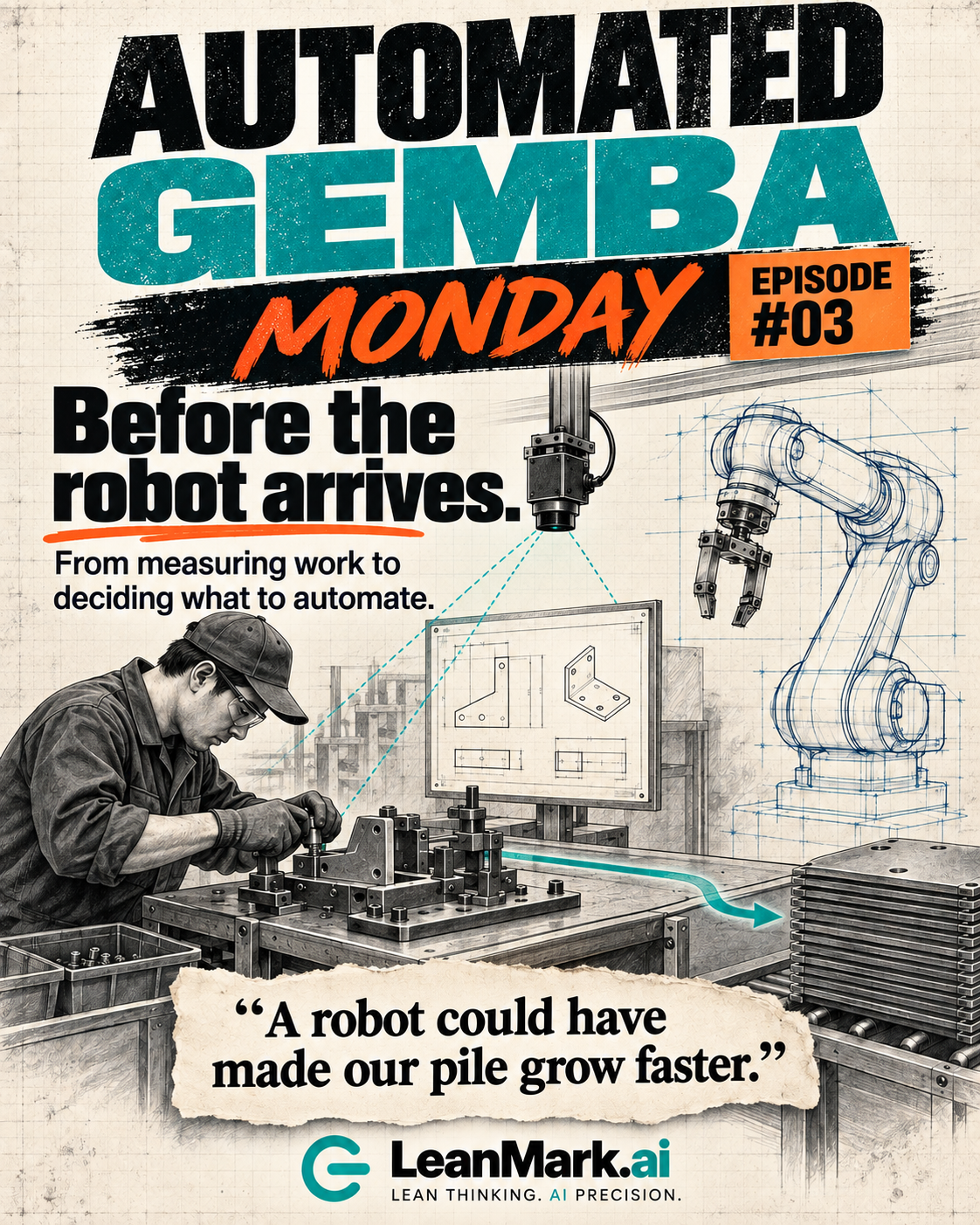
A robot could have made our pile grow faster.
In Episode 01, I wrote about our edge bender. It bent 200 panel edges a day. We shipped 70. The other 130 went onto a stack and waited days for the second side.
Put a robot at that station and you might get faster loading, steadier cycles and more output.
And a bigger stack.
That is the question I brought to this week’s tool:
If we automate this operation, what actually improves for the part travelling through the plant?
Episode 01 looked at seeing and tracking movement. Episode 02 moved closer to understanding the work: recognizing activities and measuring their duration.
Episode 03 brings in another piece of the picture: the engineering drawing.
We can see how someone handles a part. Can we also examine what about that part makes the work difficult to automate?
That interests me. I want the plant team to understand those difficulties early enough to help shape the solution.
02 / The technology
Read the work. Read the drawing.
This week’s example is Assembly Automation Assessment in Kaizen Copilot, from Retrocausal.
According to Retrocausal, the workflow combines process video with assembly and part drawings to produce an Automation Complexity Score:
- Read the work. Break a recorded assembly cycle into operations, with descriptions and proposed value classifications that the user can review and edit.
- Read the drawings. Examine factors such as geometry, joining methods, symmetry, materials, tolerances and handling requirements.
- Examine the difficulty. Assess whether individual steps have established automation methods or require new engineering, with the contributing factors available for review.
That is the manufacturer’s description. I have not tested the tool on my own parts. Explore the product and workflow.
RETROCAUSAL · KAIZEN COPILOTWatch the demonstrationAssembly Automation Assessment · Opens on YouTube ↗What interests me most is being able to question the score.
Why did this step come back difficult?
Is the part hard to grip? Does it arrive in an unpredictable orientation? Does the operator have to reposition it to reach the next feature?
Those questions give the operator and engineer something concrete to examine together.
A number becomes useful when it helps us decide what to investigate.
03 / A concept from our floor
A fixture before a robot
And that brings me to something I designed on our own floor.
We had two molding insert machines sitting apart from each other, with duplicated inventory and operators moving between them. The panel needed to be held, worked from one side, repositioned and then transferred for welding.
I kept coming back to how we presented the panel to the people doing the work.
So I designed a vacuum grid table.
The idea was to hold the panel horizontally from below, leaving its edges exposed. Two operators could work on opposite sides at the same time. The panel would then rotate vertically so its edges could be welded while it remained in the same fixture.
The aim was to bring the work together and reduce the transfers and repeated positioning between operations.
I designed it. I left before it was built.
So I cannot give you a measured cycle-time reduction or claim that it solved the problem. It was a proposed way to simplify the process, and it still needed to be tested on the floor.
But it explains why this assessment interests me.
If a tool flags repeated handling or difficult access, I want to look at the fixture and the work sequence before accepting those movements as permanent requirements.
Could we present the part differently?
Could one fixture support more of the work?
Could we remove a transfer before asking a robot to perform it?
Those are engineering questions worth answering before committing to equipment.
04 / Beyond the station
What improves in the flow?
An operation can be easy to automate and still be the wrong place to invest.
It might already produce faster than the next operation can consume.
Another operation may be difficult to automate but worth investigating because it limits delivery, causes recurring defects or puts too much physical strain on the operator.
A technical complexity assessment can inform that discussion. The decision also needs demand, quality, safety, cost and the effect on the rest of the process.
The pile behind the machine belongs in that discussion.
This is also where Episode 03 connects to the idea that started Automated Gemba: continuous VA/NVA measurement through cameras on the floor.
The video gives us evidence of what happened.
The drawing adds information about the part and its assembly requirements.
The operator helps explain the adjustments and difficulties that a clean demonstration cycle might miss.
We still need to connect that evidence to orders, replenishment, quality and the next operation.
An assembly step can look productive while its output waits for days. A handling step can look unnecessary until we understand the condition that makes it necessary today.
The VA/NVA ratio I want has to account for that context. Otherwise, we risk measuring activity very precisely and drawing the wrong conclusion.
This is why I’m excited about Lean and AI working together. We are getting more ways to examine the work. I want to use them to make better decisions on the floor.
05 / One practical experiment
A first trial on the floor
For a first trial, I would keep the scope small:
- Choose a problem the team can name. Rework, awkward handling, unreliable delivery or insufficient capacity at a specific operation.
- Capture representative work. Include different parts and normal variation. Keep track of conditions outside the camera’s view, including shortages and downstream queues.
- Review the assessment with the operator and engineering. Check the proposed steps against the real work. Investigate what drives each difficulty.
- Test a simpler arrangement. A tray, fixture, sequence change or different material presentation may change what needs to be automated.
- Reassess and define the trial. Agree on what improvement would count as success, both at the station and downstream.
A supplier may help with those questions early. The important thing is that the team brings a clear problem and stays involved in defining the answer.
I would have wanted an assessment like this while designing that table. It could have given us another way to challenge the concept and identify what needed testing.
The responsibility for understanding the process would still have been ours.
Before the robot arrives, understand the work well enough to decide what should remain.
Which operation in your plant would you simplify before committing to automation—and what would you change first?
The floor tells the truth.
MarekContinue the conversation
What would you simplify first?
Tell me about the operation, the fixture or the transfer you would change before the robot arrives.
inFind me on LinkedIn