A warehouse on screen. Trucks arriving. Forklifts moving. And a claim that it was built with Claude Opus 5.5.
I can see why that stops the scroll.
In Dilum Sanjaya’s WareTrack demonstration, warehouse software looks more like a strategy game. He says it was built with Opus 5.5, using React and React Three Fiber for the 3D parts. He also calls it a proof of concept.
That is exciting. A plant team could have a much more approachable way to inspect what is happening.
But I want to ask one question before calling it a digital twin:
Does the model show the plant—or explain how the plant works?
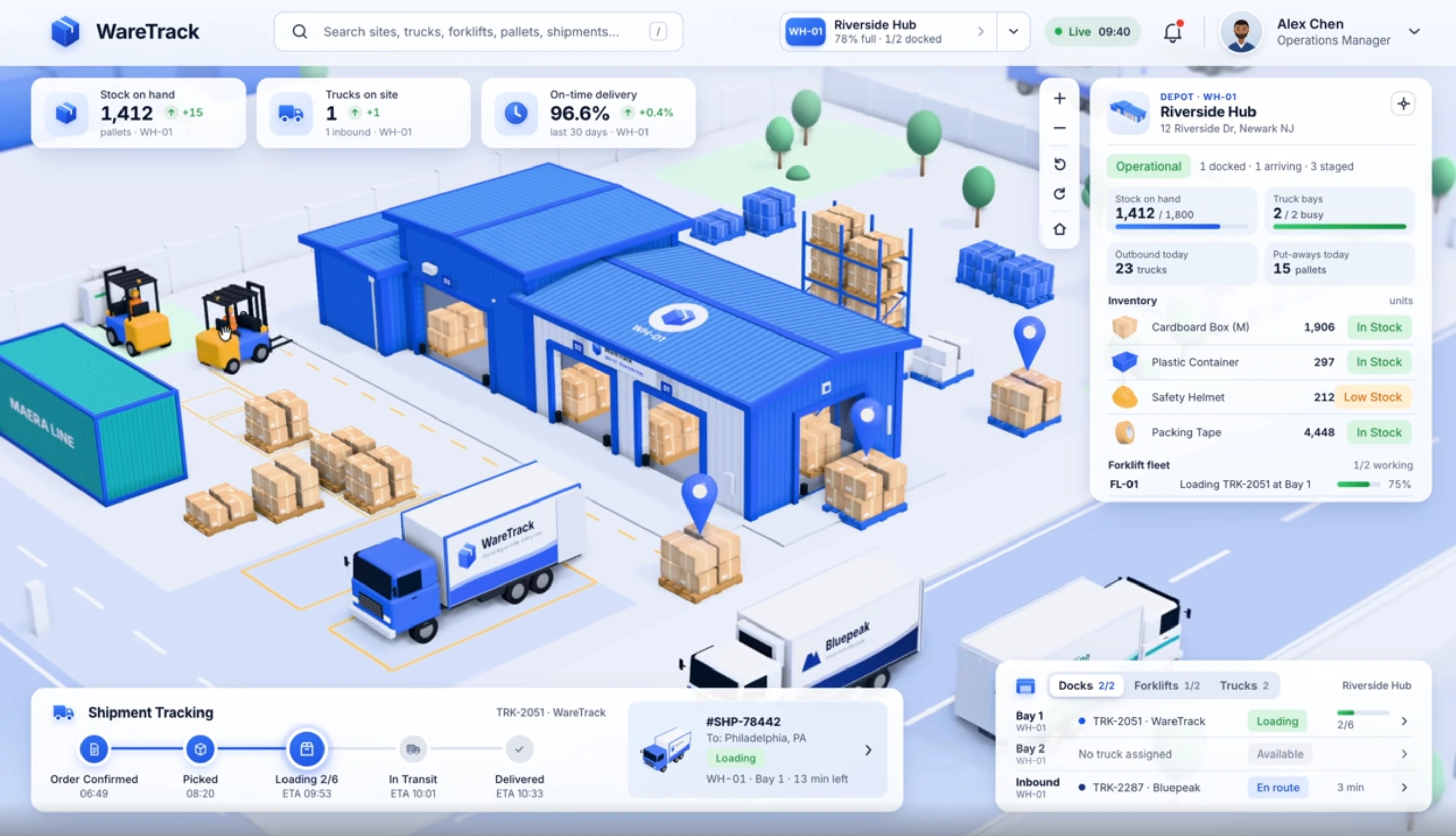
Opus 5.5 is a coding model from Anthropic. Helping write an application is one contribution. Defining the operating rules and checking the predictions is another.
02 / A second demonstration
Replay yesterday.
Change tomorrow.
Yardline, shared by Samir Tushar, gets closer to the question I would bring from the floor.
His video shows a sample day at a distribution centre: trucks, doors, pallets, queues and a timeline. He describes replaying the previous day to see bottlenecks emerge, comparing scenarios and running stress tests.
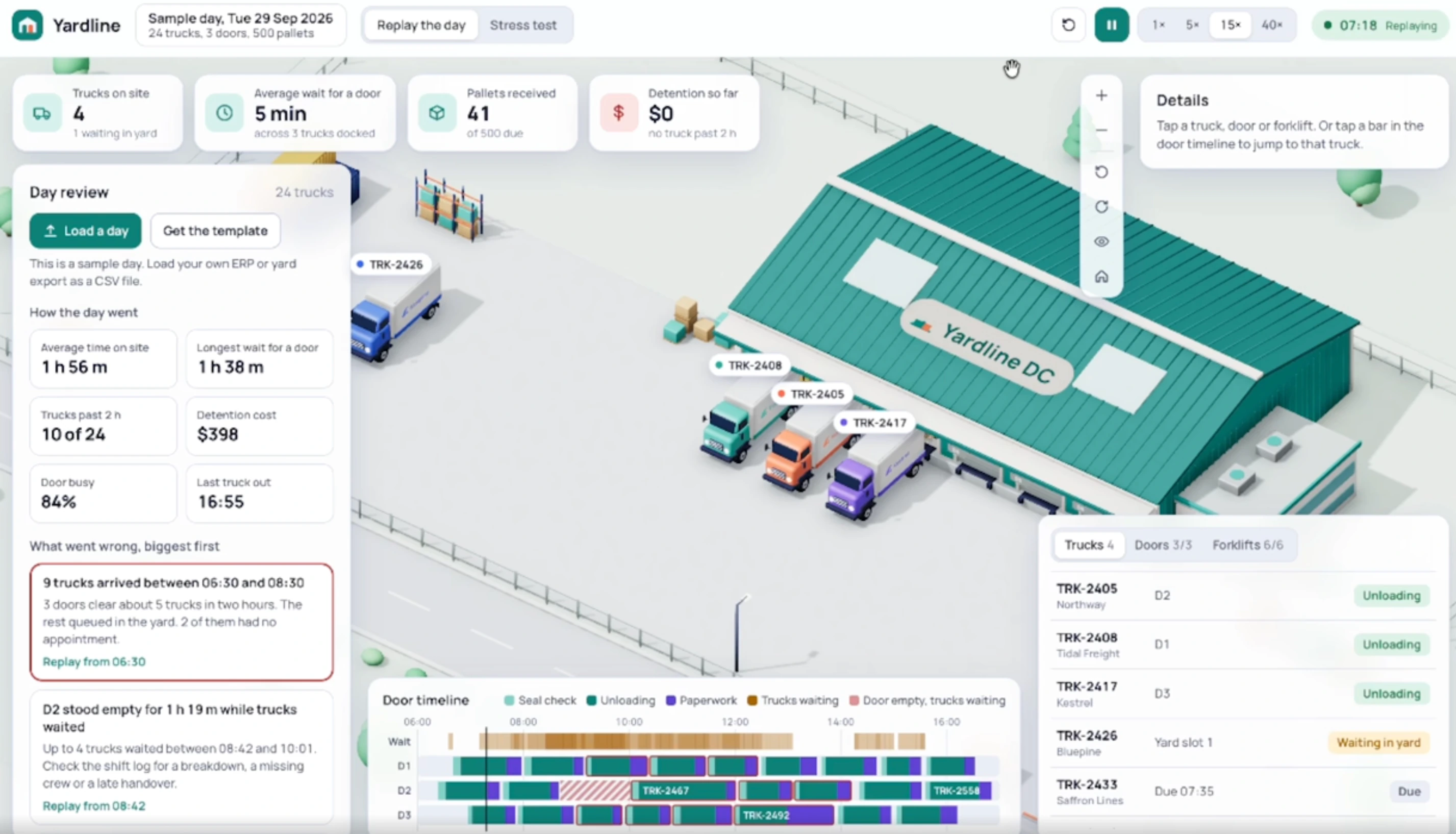
I asked whether he had built it himself in Opus 5.5. He said yes, then pointed to the harder part:
“It’s the backend rigour of rules and making it useful that’s the difficult part.”
Samir Tushar · Yardline discussion ↗
In the discussion, he explains that the replay uses already known events. The final part shows a virtual stress test, with the timeline changing as the inputs change. He still asks readers to treat it as an example.
That distinction matters. Seeing yesterday’s queue is useful. Asking whether different arrival times or unloading rules would reduce it is a further step.
The next question is whether the model’s answer holds up against the real operation.
03 / Four different jobs
What is actually a twin?
I would separate four things before comparing the software:
- 01Visualize
- Show the layout, objects and status. Help people understand what they are looking at.
- 02Replay
- Reconstruct recorded events. Show when and where the queue developed.
- 03Simulate
- Use rules for arrivals, processing, resources and routing to estimate what changes under a different scenario.
- 04Keep connected
- Maintain a model of a specific operation with relevant operational data, updated often enough for the decision it supports.
A simulation can be valuable without a live connection. A connected 3D dashboard can be valuable without predicting anything. We need to know which job we are asking it to do.
NVIDIA’s digital twin overview describes combining data about a physical counterpart with a virtual representation. For this series, I am interested in the operating model inside that representation.
If a truck waits, what prevents it from entering a door? If a machine stops, what happens to the queue? If a forklift is serving one order, can the model accidentally use it for another?
Those rules determine whether a result is useful.
04 / The platforms beside the prototype
Same screen.
Different questions underneath.
These are different kinds of tools. I have not run the same plant model through all of them, so this is a comparison of their roles and public examples, not a performance ranking.
PRODUCTION + LOGISTICS
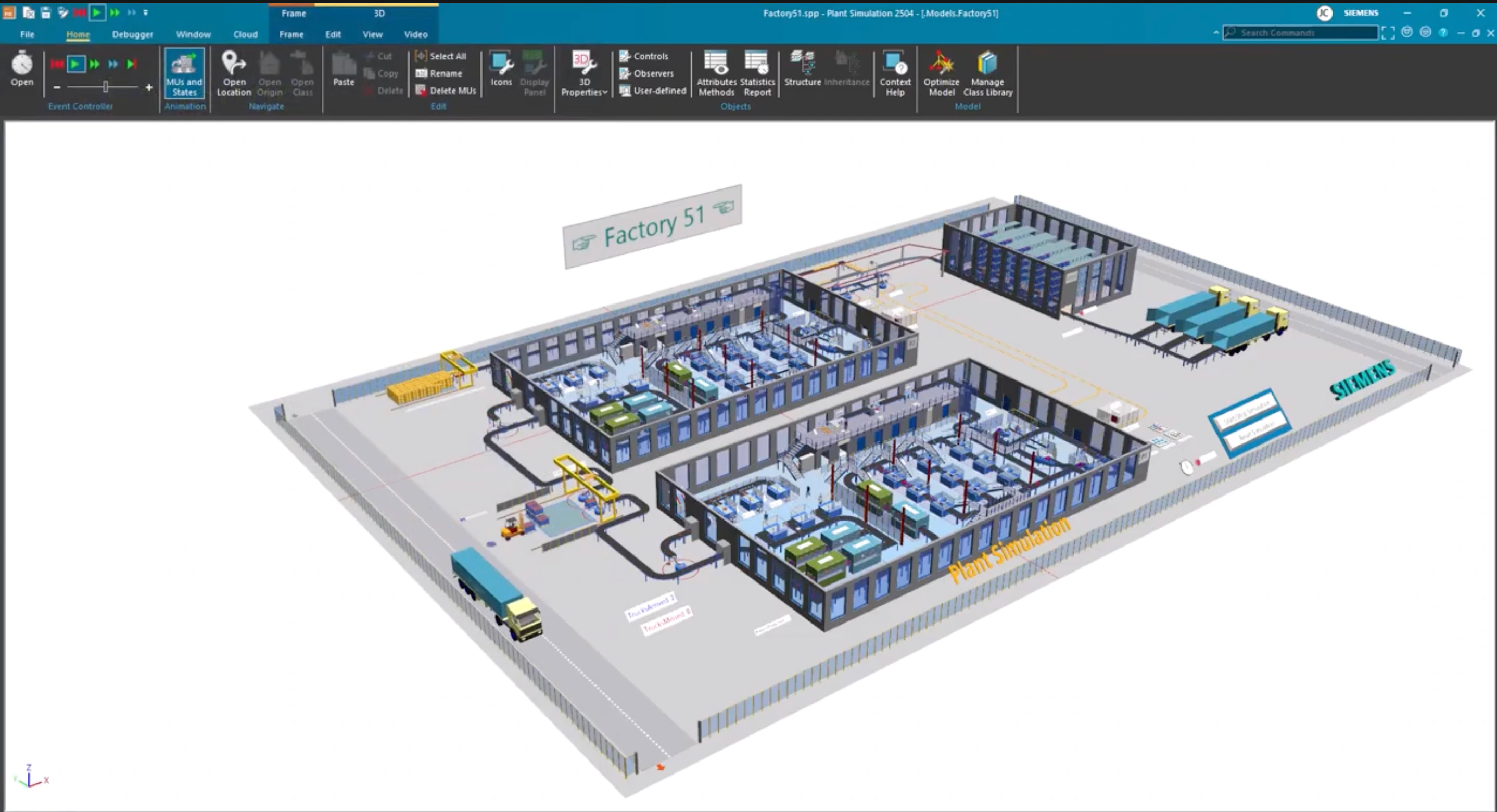
Siemens Plant Simulation
For queues, capacity and material flow, Plant Simulation is the Siemens product I would start with. Its documented scope includes throughput, resource utilization and bottleneck analysis.
My question: would changing the release rule improve shipments, or just move the queue to another station?
PHYSICAL ENVIRONMENTS + ROBOT FLEETS
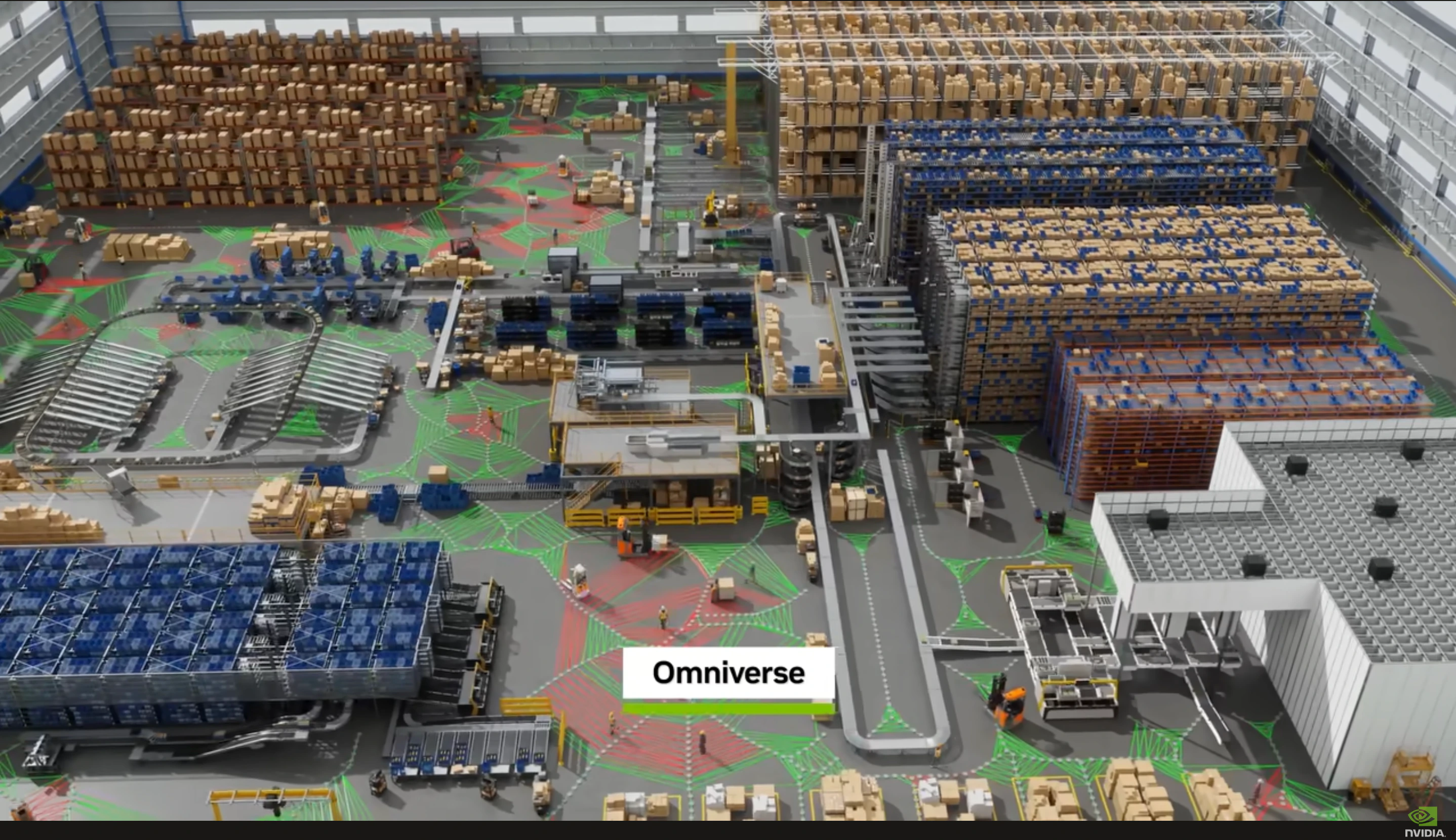
NVIDIA Omniverse
Omniverse provides libraries and infrastructure for building industrial digital twin applications. The official demonstration below shows the Mega blueprint for simulating robot fleets.
That adds questions about how robots behave in a shared physical environment. It is a different scope from a ready-made application for scheduling three loading doors.
PROCESS MODELS + SCENARIO EXPERIMENTS
AnyLogic
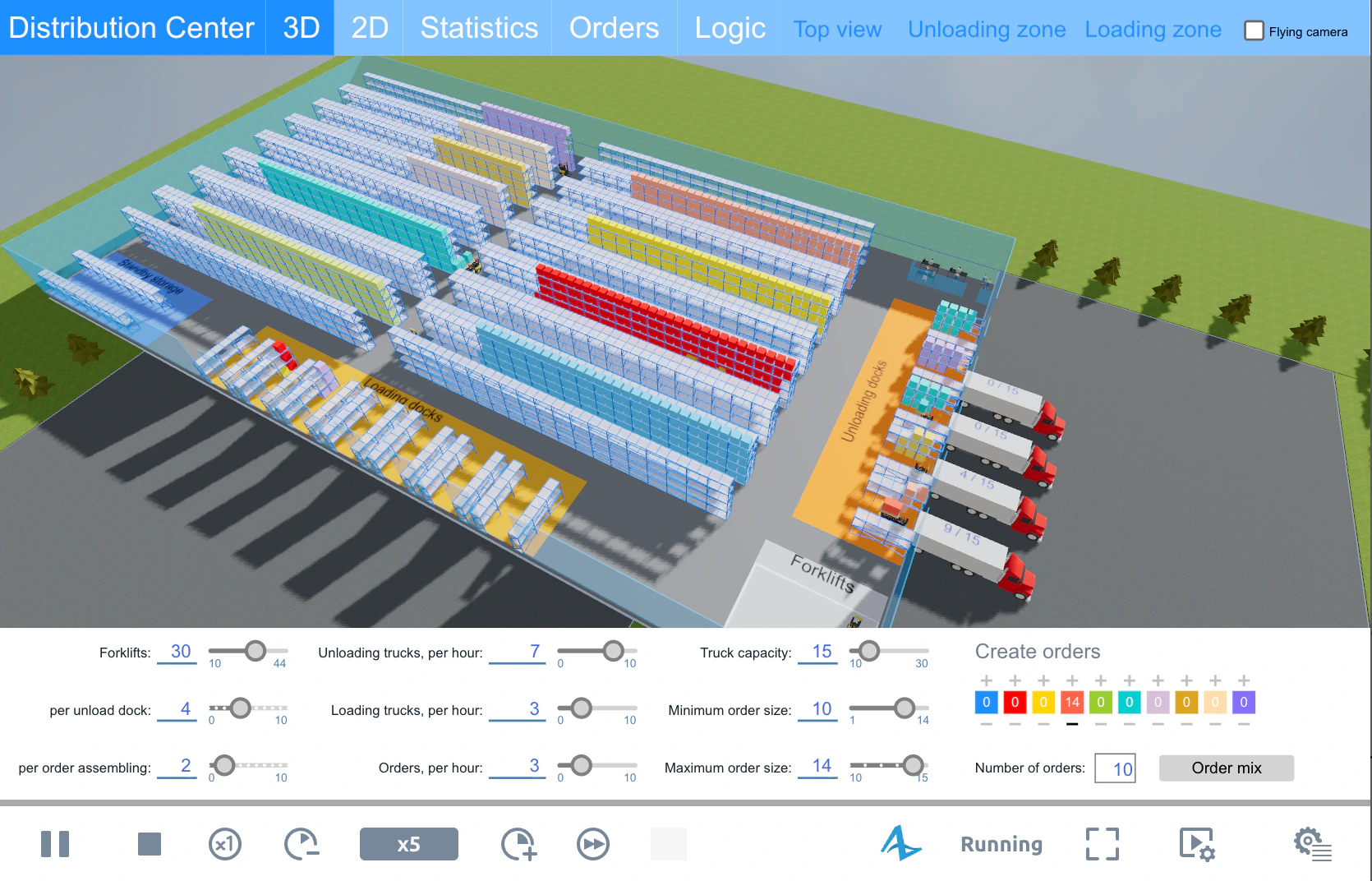
AnyLogic combines discrete-event, agent-based and system dynamics modeling. For this comparison, its public Distribution Center model is a useful example: trucks, racks, docks, orders and forklifts.
You can open the model and explore changes to parameters such as forklift count and order arrival rate. What does one extra forklift improve—and where does the next constraint appear?
MATERIAL HANDLING + WAREHOUSE DESIGN
FlexSim
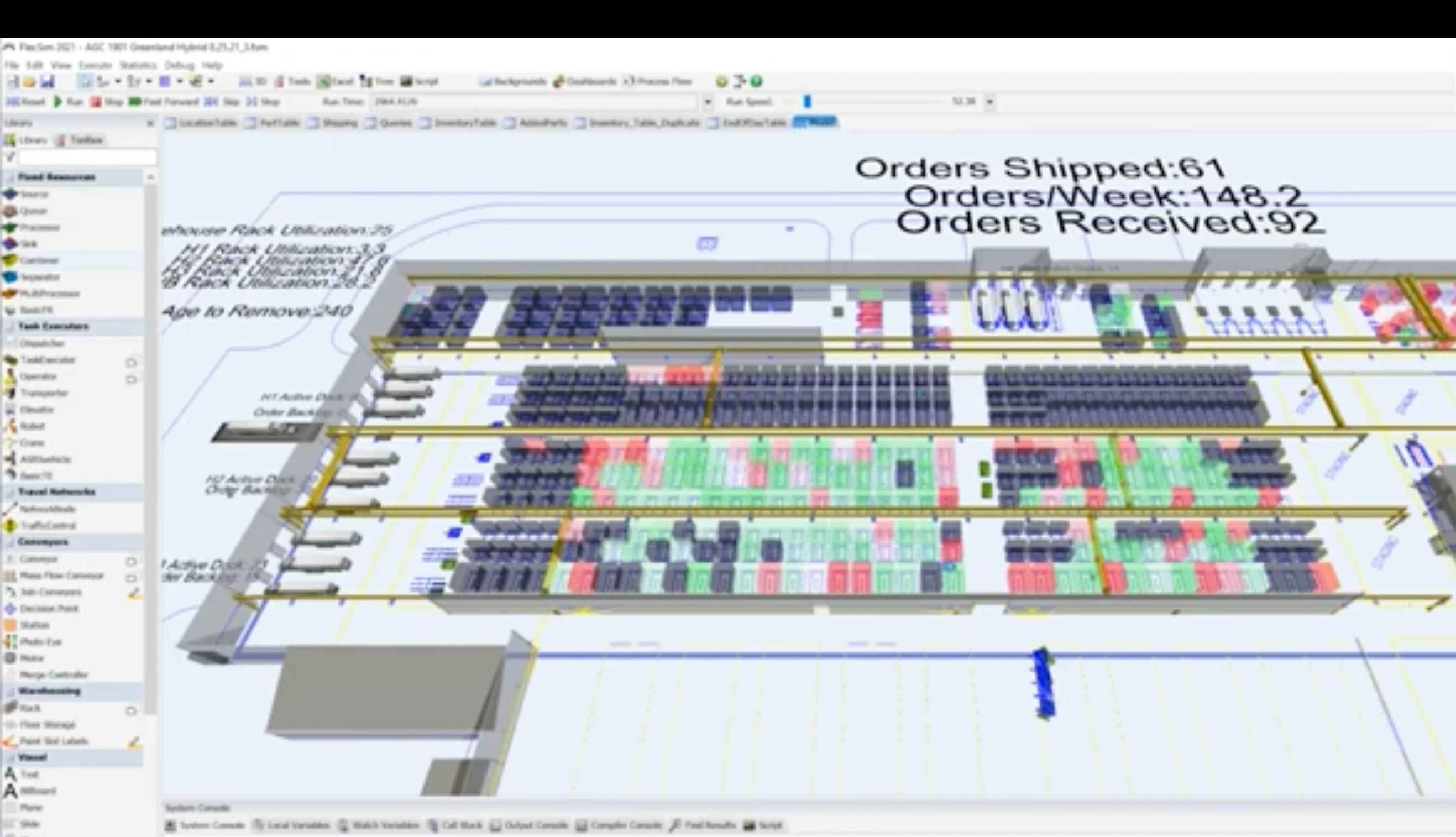
FlexSim models processes and resources in 3D. The Cardinal Glass presentation from 2021 examines warehouse storage, crane activity and shipping, then discusses a path toward connecting model-derived rules with operational systems.
It is a case study of the model and integration approach. The speakers say the later digital twin phase had not yet reached the floor at the time of the presentation.
My question: can we reduce handling and complete the shipping plan with the resources we actually have?
05 / The question in the headline
Should Siemens and NVIDIA be worried?
I think Siemens should pay attention to how quickly a useful first model can become accessible to a small plant team.
A team might start with one queue, one handoff or one scheduling problem. If AI helps build a focused application around its own data, that changes the conversation about what it needs to buy and what it can build.
That is my interpretation of the opportunity. These demonstrations do not establish that an AI-built model can replace an industrial simulation platform.
The custom application still needs dependable logic, representative data, testing, integration and somebody responsible for maintaining it.
And Siemens is already bringing AI into its tools. Its Plant Simulation X Copilot assists work with SimTalk. Siemens also announced Digital Twin Composer with NVIDIA Omniverse libraries. Siemens and NVIDIA are partners here.
AI may make the first model easier to build.
Trust still has to be earned.
I would compare two models against the same operating problem: which reproduces the bottleneck, responds credibly to a change and helps the team make a better decision?
06 / Back to our floor
The pile behind our machine
In Episode 01, our edge bender made 200 panel edges a day. We shipped 70. The rest waited for the second side.
In Episode 03, I asked what a robot would improve in that flow. It could have made the pile grow faster.
A useful model would let us examine the whole route. What happens if we release smaller batches? If the bender responds to downstream demand? If we change the capacity or sequence of the second-side operation?
I did not build that model. Those are the questions I would want to test.
I would watch completed orders, work in process and lead time. A busier machine would not be enough.
This is another step toward the idea behind Automated Gemba: continuous VA/NVA measurement informed by what is happening on the floor.
Cameras can provide evidence of the work. Process context helps explain the waiting. A simulation can help us explore a proposed change before rearranging the plant.
The operator’s knowledge still belongs in the model. So do the shortages, breakdowns and routing exceptions that a clean demonstration can leave out.
07 / One practical test
Before trusting the answer
I would begin with one problem and a short, explicit test:
- Name the decision. Which change are we considering, and what would count as an improvement?
- Build the baseline. Use actual arrivals, processing times, resource availability and routing rules. Review them with the people doing the work.
- Check another day. Test against a day that was not used to tune the model. Compare queue length, output and waiting time.
- Change one condition. A release rule, batch size, staffing level or appointment pattern. Keep the other assumptions visible.
- Test variation. Where timings are variable, run repeated trials and examine the range of outcomes.
- Take it back to the floor. Agree on a controlled trial and compare what happened with what the model predicted.
The model only needs the detail required for that decision. But the rules that drive the answer must be right enough to support it.
The useful twin is the one that helps us decide what to change next.
If AI helped you build a model of your plant, what would you ask it to test first?
The floor tells the truth.
MarekContinue the conversation
What would you test first?
One queue, one transfer, one release rule. Tell me which decision a model would help you make on your floor.
inFind me on LinkedIn